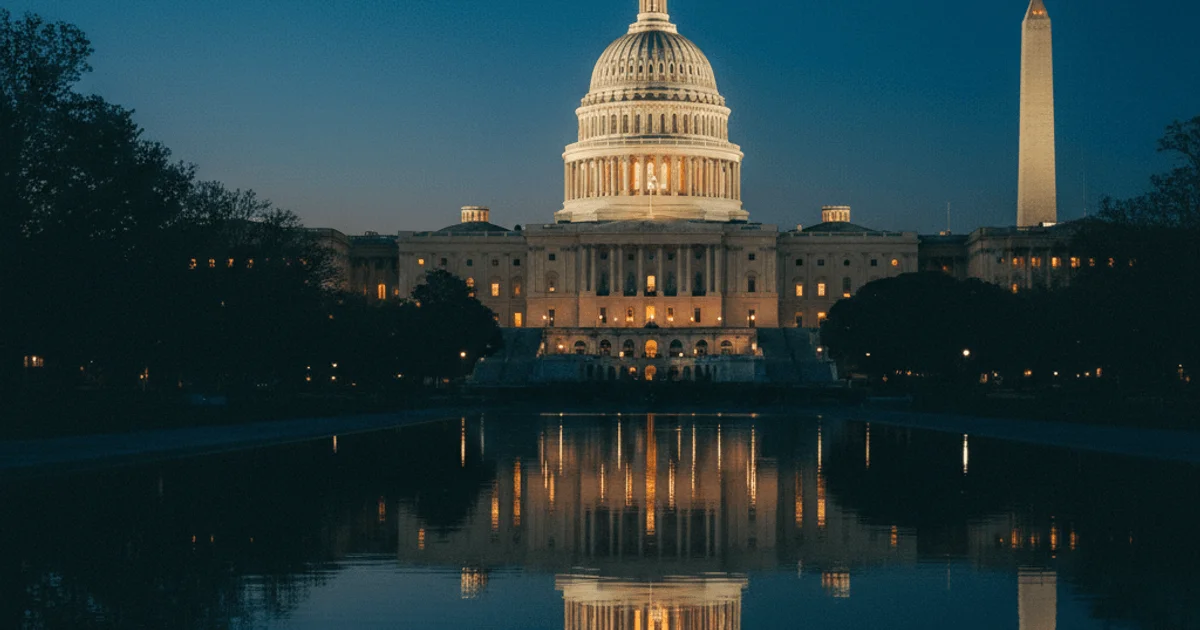
Three percent. That’s what Washington DC allocates to streaming in legal advertising. DMA #8. The nation’s capital. Home to one of the most educated, highest-income, most digitally connected populations in America. And legal advertisers here treat CTV like it doesn’t exist.
Atlanta puts 48% into streaming. Houston allocates 18%. Washington DC puts 3%. That’s $78K monthly across the entire market. Some individual attorneys in mid-sized markets spend more than that on CTV alone.
The numbers tell a story of a market in decline. Total spend sits at $2.6 million monthly, down 39% year-over-year. Morgan & Morgan dominates at 31.1% ($810K). Broadcast captures 73%. This is a market frozen in a strategy from 2015.
Morgan’s Stronghold
Morgan & Morgan’s 31.1% market share in Washington DC ranks among their highest nationally. In most markets, they compete for 15% to 20%. Here, they’ve established a different level of control.
The Washington DC market data maps the full competitive picture. The reason is partly competitive. DC’s legal market skews toward government-adjacent practices, white-collar work, and regulatory law. PI advertising carries less weight here than in car-accident-heavy markets like Houston or Dallas. The firms that do advertise are fewer and less aggressive than in Sun Belt DMAs.
Marks & Harrison at $319K (12.2%) and Cochran Firm at $278K (10.7%) hold second and third. Saiontz & Kirk runs $225K (8.6%). Mike Slocumb at $166K (6.4%) rounds out the top five. Combined, these five firms control nearly 70% of the market. The remaining 30% scatters across dozens of small advertisers.
A Market in Retreat
The 39% decline year-over-year is striking. While ATRA documents $2.5 billion in annual legal advertising nationally with consistent growth, DC moves in the opposite direction. Some of that reflects political advertising cycles. Election years soak up broadcast inventory, driving legal advertisers to scale back or face inflated rates. Post-election, the vacuum opens but firms don’t always rush back in.
But the decline also reflects a deeper issue. DC’s legal advertising market hasn’t adapted. The firms spending here rely on broadcast at 73%, the highest traditional TV allocation we track. Cable takes just 1%. Radio captures 22%. CTV gets the scraps.
When your market declines 39% and your competitors cling to broadcast, two things happen. Broadcast inventory gets cheaper (fewer bidders). And the audience that already moved to streaming becomes entirely unreached by legal advertising.
The 3% Anomaly
Nielsen documented 47.5% streaming share of total TV viewing in December 2025. Washington DC’s digital adoption metrics rank among the highest in the nation. The population streams. They stream a lot. They just don’t see legal ads while they do it.
Compare that 3% to the broader landscape. Philadelphia allocates 15%. Boston puts 12%. Even markets half DC’s size allocate five to seven times more to streaming.
The gap creates an extraordinary first-mover opportunity. A firm that deploys even $50K monthly in DC CTV advertising would instantly become the dominant streaming legal advertiser in the eighth-largest television market in America. That’s not a hypothetical. At 3% allocation, the bar for dominance is almost nonexistent.
The Three-State Complication
The DC DMA spans three jurisdictions: the District, Northern Virginia, and suburban Maryland. Each has different bar advertising rules. Each has different court systems. A firm licensed in Virginia but not Maryland wastes money reaching Maryland viewers through broadcast.
This is where CTV’s targeting advantage becomes decisive. Streaming platforms target by zip code, by state, by jurisdiction. A Virginia PI firm can serve ads exclusively to Northern Virginia households. A Maryland firm can target Montgomery and Prince George’s County without paying for DC impressions.
Broadcast can’t do that. A spot on WJLA reaches the entire DMA. Every dollar spent on broadcast bleeds into jurisdictions where the firm can’t practice. In a three-state DMA, that waste adds up fast.
The Contrarian Play
DC’s declining market and Morgan & Morgan’s 31% share might look like reasons to avoid this DMA. The opposite is true.
A declining market means cheaper inventory. Lower competition. Morgan’s broadcast dominance means they’ve locked up the traditional channel but left streaming wide open. The 39% decline means fewer competitors are paying attention. And the 3% CTV allocation means the first serious streaming advertiser in this market operates in a vacuum.
Marks & Harrison and Saiontz & Kirk have the budgets to make this move. A $100K to $150K monthly CTV deployment would represent a fraction of their current broadcast spend but would make them the undisputed streaming leader in an 8th-largest DMA.
Washington DC is the single biggest CTV opportunity in American legal advertising. Not the biggest market. Not the highest growth. But the widest gap between where the audience is and where the advertisers are. Someone will close that gap. The math guarantees it.
References
- Nielsen. "2024-2025 Local Television Market Universe Estimates." 2024.
- Nielsen. "Streaming Shatters Multiple Records in December 2025 with 47.5% of TV Viewing." 2026.
- ATRA. "Legal Services Advertising in the United States, 2020-2024." 2025.
- Virginia Highway Safety Office. "Virginia Traffic Crash Facts, 2024." 2025.